What Are APFC Panels? How They Save Your Factory Money on Electricity
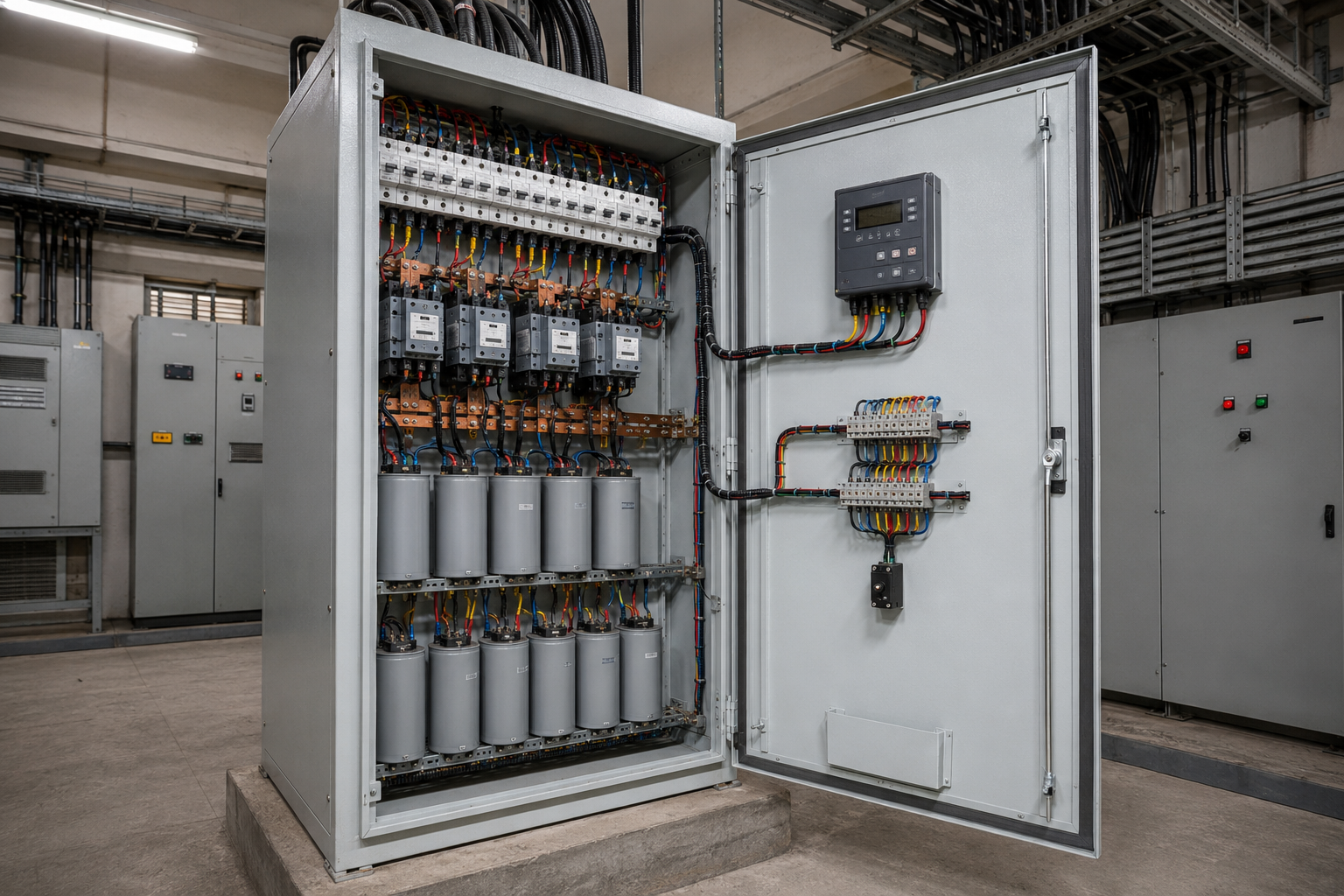
An APFC panel — Automatic Power Factor Correction panel — automatically improves your factory's power factor, reducing electricity bills and avoiding utility penalties. This guide explains what APFC panels are, how they work, why every industrial plant in India needs one, and how Standard Machinery in Bhavnagar, Gujarat, custom-builds APFC panels to order at competitive factory-direct prices.
What Is an APFC Panel? A Plain-Language Definition
An APFC panel — short for Automatic Power Factor Correction panel — is an electrical panel that automatically monitors and corrects the power factor of an industrial facility. It does this by switching capacitor banks in and out of the electrical circuit in real time, keeping the power factor as close to unity (1.0) as possible.
In simple terms: most industrial loads — motors, compressors, transformers, welding machines — consume not just active (useful) power but also reactive (wasted) power. A poor power factor means your facility draws more current than it actually needs for productive work. This wastes energy, overloads cables and switchgear, and attracts penalty charges from the electricity utility.
Standard Machinery, based in Bhavnagar, Gujarat, India, custom-builds APFC panels to order for factories, industrial plants, commercial buildings, and construction projects. Each panel is designed and assembled to match the specific load profile and incoming supply of the customer's facility.
Understanding Power Factor: Why It Matters for Your Electricity Bill
Before understanding APFC panels, it helps to understand power factor — the root problem these panels solve.
What Is Power Factor?
Power factor is the ratio of active power (kW) — the power that actually does useful work — to apparent power (kVA) — the total power drawn from the grid. It is expressed as a number between 0 and 1, or as a percentage.
A power factor of 1.0 (or 100%) means all the power drawn from the grid is being used productively. A power factor of 0.7 means only 70% of the drawn power is doing useful work — the remaining 30% is reactive power circulating in the system and generating heat and losses without contributing to output.
What Causes Poor Power Factor in a Factory?
Inductive loads are the primary cause of poor power factor in industrial facilities. These include:
• AC induction motors — the most common cause in any factoryElectric Motors:
• Transformers operating at partial loadTransformers:
• Compressors, pumps, and blowers with induction motor drivesCompressors & Pumps:
• Induction furnaces and resistance heating equipmentFurnaces:
• Fluorescent and HID lighting with magnetic ballastsIndustrial Lighting:
Most Indian factories running multiple motors — submersible pumps, blowers, compressors, conveyor drives — will have a naturally poor power factor without correction. This directly increases your electricity bill and can attract surcharge penalties from DISCOM (distribution companies).
Power Factor Penalties in India
Indian electricity regulators require industrial consumers to maintain a minimum power factor — typically 0.90 or above for HT (high tension) consumers. Falling below this threshold attracts a power factor surcharge on the electricity bill — which can add significantly to monthly costs for medium and large industrial consumers.
Conversely, maintaining a power factor above the target — typically 0.95 or above — can earn a power factor incentive rebate from the utility, directly reducing your monthly electricity bill.
How Does an APFC Panel Work?
An APFC panel works by automatically adding capacitive reactive power to counteract the inductive reactive power drawn by motors and other inductive loads. This process — called power factor correction — brings the net power factor of the facility back towards unity.
The APFC Panel Operating Sequence
• Power factor relay / controller continuously monitors the power factor at the incoming supply pointStep 1 — Monitor:
• When power factor drops below the target setpoint, the controller sends a signal to switch in a capacitor bankStep 2 — Detect:
• A contactor switches the capacitor bank into the circuit, injecting reactive power and correcting the power factorStep 3 — Correct:
• If the power factor overshoots, the controller switches out a capacitor bank to prevent leading power factorStep 4 — Balance:
• This switching process repeats continuously — automatically — as loads change throughout the working dayStep 5 — Repeat:
The "Automatic" in APFC refers to this real-time, closed-loop control. Unlike manual or fixed capacitor banks, an APFC panel responds instantly to load changes — morning startup, shift changes, heavy load cycles — without any operator intervention.
Key Components Inside an APFC Panel
A properly built APFC panel contains several critical components, each performing a specific role in the power factor correction process.
|
Component |
Function |
|
Power Factor Relay / Controller |
Measures power factor continuously and sends switching commands to contactors |
|
Capacitor Banks |
Inject reactive power into the circuit to raise power factor — available in steps (e.g. 5 kVAR, 10 kVAR, 25 kVAR) |
|
Contactors |
Switch capacitor banks in and out of the circuit on command from the relay |
|
MCB / MCCB |
Incoming protection and individual capacitor bank protection |
|
Fuses |
Short-circuit protection for each capacitor bank |
|
Harmonic Detuning Reactors (optional) |
Prevent resonance issues in systems with variable frequency drives (VFDs) or non-linear loads |
|
Metering (optional) |
kW, kVAR, kVA, and power factor display for monitoring and energy management |
|
Enclosure |
Powder-coated steel panel with cable entry, ventilation, and IP-rated door |
Benefits of Installing an APFC Panel in Your Factory
For Indian factory owners and plant managers, an APFC panel is one of the highest-return electrical investments available. The benefits are direct, measurable, and often pay back the installation cost within 12 to 24 months.
• Elimination of power factor surcharge penalties on monthly electricity billsReduced Electricity Bills:
• Earning of power factor incentive rebates from the utility (for PF above 0.95)Utility Rebates:
• Lower current draw for the same active power — reducing heat in cables, switchgear, and transformersReduced System Losses:
• Increased capacity of existing transformers, cables, and switchgear without upgradesReleased System Capacity:
• Improved voltage stability — less voltage drop under heavy loadBetter Voltage Quality:
• Extended life of motors, cables, and switchgear due to lower operating currentEquipment Longevity:
For a factory running multiple motors — pumps, compressors, blowers, conveyor drives — the monthly saving from APFC can be substantial. In many cases, a well-sized APFC panel pays for itself within the first year of operation.
Which Industries and Facilities Need an APFC Panel?
Any industrial or commercial facility with a significant number of inductive loads — especially motors — benefits from power factor correction. Standard Machinery supplies custom APFC panels to the following sectors:
• Textile mills, weaving and spinning plants with large motor loadsTextile Industry:
• Chemical and pharmaceutical plants with compressors, agitators, and pumpsChemical Plants:
• Steel re-rolling mills and metal fabrication plantsSteel & Metal Plants:
• Food processing plants with refrigeration compressors and conveyor drivesFood Processing:
• Construction sites and ready-mix concrete plants with multiple motor loadsConstruction Sites:
• Commercial buildings, hospitals, hotels with HVAC compressor loadsCommercial Buildings:
• Water treatment plants with multiple pump motorsWater & Sewage Plants:
If your electricity bill shows a power factor surcharge or your DG set / transformer is frequently running near full load, an APFC panel from Standard Machinery is the practical, cost-effective solution.
Why Standard Machinery Is the Right Choice for APFC Panels
Standard Machinery is an experienced electrical panel builder based in Bhavnagar, Gujarat, India. The team custom-builds APFC panels — along with starter panels, distribution panels, VFD panels, lift panels, and fire panels — for factories, contractors, and industrial projects across Gujarat, Maharashtra, and beyond.
Every APFC panel from Standard Machinery is built to the customer's specific load requirement. The total kVAR compensation needed, the number of capacitor steps, the controller type, and the enclosure rating are all configured based on the actual site conditions — not a standard off-the-shelf design.
Why factory owners and contractors choose Standard Machinery for APFC panels:
• Custom-designed to your site's kVAR requirement and load profileMade to Order:
• Quality components — reliable power factor relays, contactors, and capacitor banksQuality Build:
• Factory-direct pricing — no distributor markupCompetitive Price:
• Full wiring diagram and documentation supplied with every panelDocumentation:
• Supplying Gujarat, Maharashtra, Rajasthan, and pan-IndiaWide Supply:
• Fast turnaround on standard configurationsQuick Delivery:
Discuss your APFC panel requirement with the Standard Machinery team at +91 88666 69293 or visit standardmachinery.store to enquire about pricing and lead times.
Frequently Asked Questions (FAQ)
Q: What does APFC panel stand for?
A: APFC stands for Automatic Power Factor Correction. An APFC panel is an electrical panel that automatically monitors and corrects the power factor of an industrial or commercial facility by switching capacitor banks in and out of the circuit in real time.
Q: Is an APFC panel mandatory for factories in India?
A: While not universally mandatory, Indian electricity regulators require HT (high tension) industrial consumers to maintain a minimum power factor — typically 0.90. Falling below this attracts penalty surcharges on the electricity bill. Installing an APFC panel is the standard solution and is effectively compulsory for any facility that wants to avoid these penalties.
Q: What is the difference between an APFC panel and a fixed capacitor bank?
A: A fixed capacitor bank provides a constant amount of reactive power compensation — it does not adjust to changing loads. An APFC panel automatically switches capacitor banks in steps to match the actual reactive power demand at any given moment. This makes APFC panels far more efficient and effective for facilities with variable loads.
Q: How do I know what kVAR rating my APFC panel needs?
A: The required kVAR is calculated from your facility's existing power factor, active load (kW), and target power factor. Standard Machinery's team can help size the correct APFC panel for your site. Share your electricity bill (which shows kW, kVAR, and current power factor) and contact +91 88666 69293 for a sizing recommendation.
Q: Can Standard Machinery build a custom APFC panel for my factory?
A: Yes. Standard Machinery custom-builds APFC panels from its workshop in Bhavnagar, Gujarat. Each panel is configured to the customer's specific kVAR requirement, number of capacitor steps, controller type, and enclosure rating. Contact +91 88666 69293 or visit standardmachinery.store to discuss your requirement and get a quote.
Conclusion: Stop Paying Power Factor Penalties — Act Now
An APFC panel is not a luxury — it is a practical, high-return investment for any Indian factory or industrial plant running motors, compressors, pumps, or other inductive loads. The savings on electricity bills and the elimination of utility penalties typically pay back the panel cost within one to two years.
For a custom-built APFC panel designed specifically for your facility's load profile, Standard Machinery delivers factory-direct quality at competitive prices from Bhavnagar, Gujarat. Visit standardmachinery.store or call / WhatsApp +91 88666 69293 to discuss your requirement and get a quote today.