What Are Fire Panels? Types, Uses & Custom Supply in India
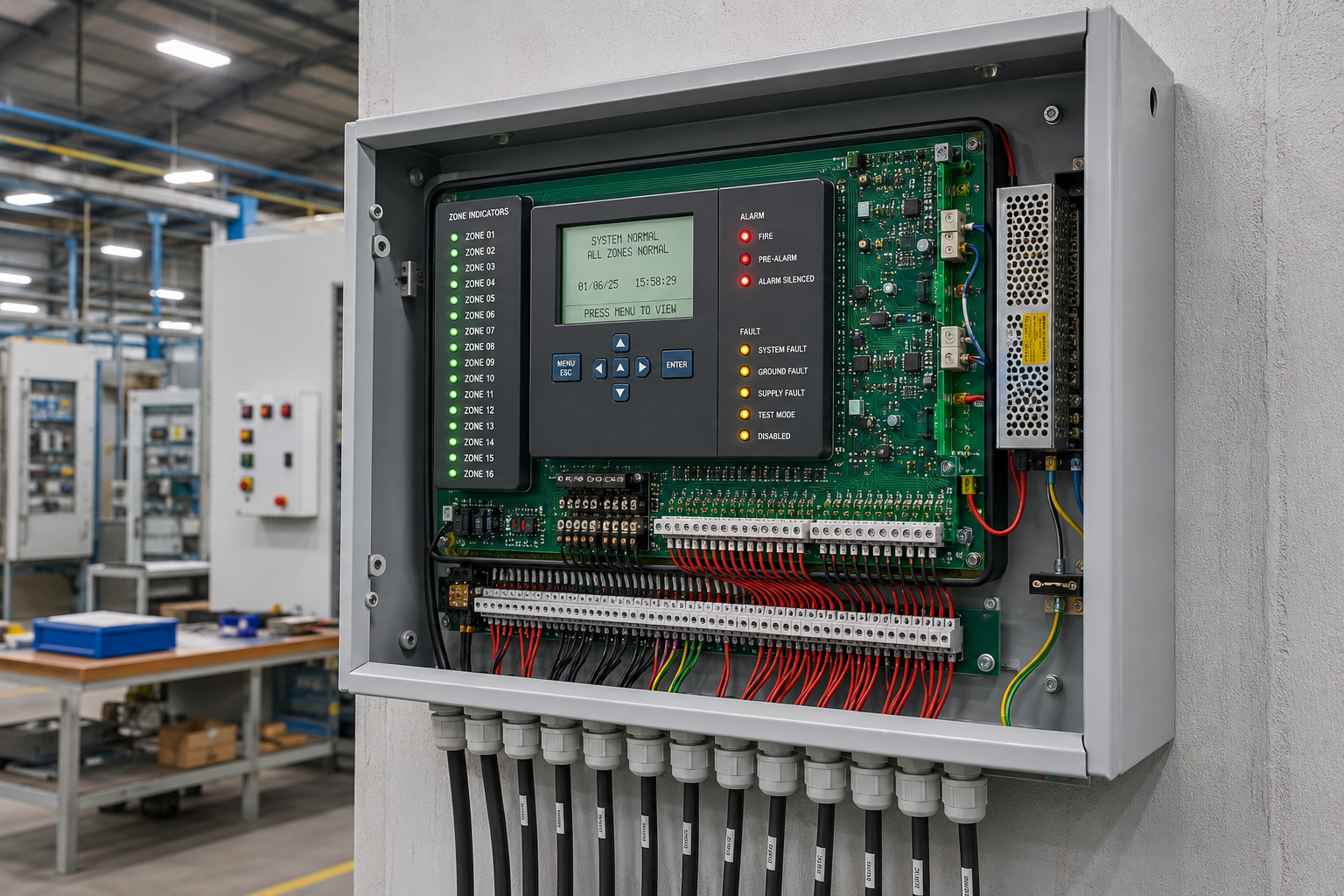
A fire panel — also called a fire alarm control panel — is the central hub of any building or industrial fire detection and alarm system. This guide explains what fire panels are, how they work, the different types available, and how Standard Machinery in Bhavnagar, Gujarat, custom-builds fire panels to order for factories, warehouses, and commercial installations across India.
What Is a Fire Panel? A Clear Definition
A fire panel — formally known as a Fire Alarm Control Panel (FACP) — is the central control unit of a fire detection and alarm system. It receives signals from fire detectors, smoke sensors, heat detectors, and manual call points installed throughout a building or facility. When a trigger is detected, the fire panel activates alarms, alerts personnel, and can interface with suppression systems or building management systems.
In simple terms: the fire panel is the brain of a fire safety system. Every detector, alarm sounder, and suppression trigger in the building is connected back to the fire panel — which monitors, processes, and responds to fire signals 24 hours a day.
Standard Machinery, based in Bhavnagar, Gujarat, India, custom-builds fire panels to order for industrial facilities, warehouses, commercial buildings, and construction projects. Each panel is assembled to the specific zone, detector, and load requirements of the customer's site.
How Does a Fire Panel Work?
Understanding how a fire panel works helps you specify the right system for your facility. The process follows a clear sequence from detection to response.
Step 1 — Detection
Fire detectors — smoke detectors, heat detectors, flame detectors, or gas detectors — are installed throughout the protected area. Each device monitors its zone continuously and sends a signal to the fire panel the moment a fire condition is detected.
Step 2 — Signal Processing
The fire panel receives the incoming signal and identifies which zone it has come from. On an addressable fire panel, the exact device that triggered the alarm is identified. On a conventional fire panel, the zone — but not the specific device — is identified.
Step 3 — Alarm Activation
The panel triggers the alarm output — activating sounders, bells, strobe lights, or voice evacuation systems throughout the building. Simultaneously, it can send a signal to a remote monitoring station, the building management system, or a fire suppression system.
Step 4 — Fault and Monitoring
A fire panel also continuously monitors the connected devices for faults — open circuits, short circuits, or device failures. A fault condition is displayed on the panel's LED or LCD interface, allowing maintenance teams to identify and fix issues before they compromise fire safety.
Types of Fire Panels Available in India
There are three main types of fire alarm control panels used in Indian industrial and commercial installations. The right choice depends on the size of the facility, the number of detection points, and the level of location detail required.
|
Panel Type |
How It Works |
Best For |
Zone Identification |
|
Conventional |
Devices grouped by zone on shared wiring loop |
Small buildings, warehouses, budget projects |
Zone only |
|
Addressable |
Each device has a unique address — exact location shown |
Factories, large commercial buildings, hospitals |
Exact device |
|
Analogue Addressable |
Devices report signal level — panel assesses fire vs fault |
High-risk facilities, complex industrial sites |
Exact device + condition level |
Conventional Fire Panels
Conventional fire panels divide the protected area into zones. All detectors in a zone are wired together on the same loop. When any device in that zone triggers, the panel shows which zone is affected — but not which specific device.
Conventional panels are cost-effective and straightforward to install. They are the most common choice for small to medium-sized buildings — warehouses, small factories, shops, and residential complexes.
Addressable Fire Panels
Addressable panels assign a unique address to every detector, sounder, and call point on the system. When a device triggers, the panel displays the exact location — the specific device, not just the zone. This dramatically speeds up fire response and reduces unnecessary evacuations from false alarms.
Addressable panels are the standard choice for large factories, multi-storey industrial buildings, hospitals, hotels, and any facility where precise location identification is critical.
Analogue Addressable Fire Panels
The most advanced type, analogue addressable panels receive a continuous signal level from each device — not just an on/off trigger. The panel's processor analyses the signal to determine whether a condition is a genuine fire, a developing pre-fire condition, or a dust/fault false alarm. This dramatically reduces false alarms and allows predictive maintenance.
Key Components of a Fire Panel
A fire panel — whether conventional or addressable — contains several core components that work together to detect and respond to fire conditions.
• Central processor that receives and processes all incoming detector signalsControl PCB / Processor:
• Rechargeable backup battery — typically 24V sealed lead-acid — to maintain operation during mains power failureStandby Battery:
• Outputs to activate bells, sounders, and strobe lights when an alarm is triggeredAlarm Output Circuits:
• Relay outputs to interface with sprinklers, gas suppression, lifts, and HVAC shutdownAuxiliary Relay Outputs:
• LCD or LED display showing zone status, alarm, fault, and system conditionDisplay Interface:
• On-panel controls for testing, resetting, silencing, and isolating zonesOperator Controls:
• Input terminals for connecting detectors, manual call points, and ancillary devicesZone Input Terminals:
Where Are Fire Panels Used? Industrial and Commercial Applications
Fire panels are a legal and practical requirement in a wide range of Indian industrial and commercial facilities. Standard Machinery custom-builds fire panels for the following applications:
• Manufacturing plants and process industries — chemical, textile, food, pharmaceuticalFactories & Plants:
• Warehouses and cold storage facilities with high-value inventoryWarehouses:
• Commercial buildings — offices, malls, hotels, hospitalsCommercial Buildings:
• Construction site offices, temporary structures, and on-site facilitiesConstruction Sites:
• Shipyards, port facilities, and marine-related industrial sites near Alang and BhavnagarMarine & Port Sites:
• Pump stations, generator rooms, and electrical substation buildingsUtility Rooms & Substations:
Any facility where electrical equipment, flammable materials, or large numbers of people are present requires a properly specified and installed fire detection and alarm system with a suitable fire panel at its centre.
Custom-Built Fire Panels from Standard Machinery
Standard Machinery custom-builds fire panels to order from its facility in Bhavnagar, Gujarat. Each fire panel is assembled based on the specific requirements of the customer's site — including the number of zones, detector types, alarm output requirements, battery backup capacity, and enclosure specification.
This made-to-order approach means the customer receives a panel that is correctly sized and configured for their application — not an off-the-shelf unit that may be over- or under-specified. Standard Machinery's panel-building expertise extends across its full range of custom panels: starter panels, lift panels, APFC panels, distribution panels, VFD panels, and fire panels.
What Standard Machinery provides with each custom fire panel:
• Zone configuration matched to the customer's floor plan and detector layoutCustom Zoning:
• Conventional or addressable panel type based on site complexity and budgetPanel Type Selection:
• Standby battery sized for minimum 24-hour monitoring + 30-minute alarm operationBattery Backup:
• Relay outputs pre-wired for suppression, HVAC, or lift interface as requiredRelay Outputs:
• Sturdy metal enclosure rated for industrial environmentsIndustrial Enclosure:
• Full wiring diagram and termination schedule supplied with each panelDocumentation:
For fire panel enquiries, contact Standard Machinery at +91 88666 69293 or visit standardmachinery.store to discuss your site requirements.
Why Standard Machinery Is the Right Choice for Fire Panels
Standard Machinery is an industrial electrical panel builder and machinery supplier based in Bhavnagar, Gujarat, India. The business has built a strong reputation across Gujarat and Maharashtra for supplying custom-built electrical panels — starter panels, distribution panels, VFD panels, APFC panels, lift panels, and now fire panels — to factories, contractors, and site engineers.
Alongside custom panel building, Standard Machinery also sources and supplies refurbished industrial machinery from Alang Ship Breaking Yard — Asia's largest ship recycling facility, located minutes from the Standard Machinery workshop in Bhavnagar. This dual capability — custom panel building and refurbished machinery supply — makes Standard Machinery a one-stop industrial supplier for construction and factory projects.
Reasons to choose Standard Machinery for your fire panel:
• Custom-built to your zone count and detector layout — no off-the-shelf compromiseMade to Order:
• Experienced panel-building team with a track record across multiple panel typesProven Expertise:
• Competitive pricing — direct from the builder, no distributor markupFactory-Direct Price:
• Supplying Gujarat, Maharashtra, Rajasthan, and pan-IndiaWide Coverage:
• Fast turnaround on standard configurationsQuick Dispatch:
• Full wiring documentation included with every panelDocumentation Supplied:
Discuss your fire panel requirement with the Standard Machinery team at +91 88666 69293 or browse the panel range at standardmachinery.store.
Frequently Asked Questions (FAQ)
Q: What is a fire panel and what does it do?
A: A fire panel — also called a Fire Alarm Control Panel (FACP) — is the central control unit of a fire detection and alarm system. It receives signals from smoke detectors, heat detectors, and manual call points, activates alarms when a fire is detected, and displays fault and zone status information to building occupants and maintenance teams.
Q: What is the difference between a conventional and addressable fire panel?
A: A conventional fire panel identifies which zone of the building has triggered an alarm — but not the specific device. An addressable fire panel identifies the exact detector or call point that has triggered, giving precise location information. Addressable panels are preferred for larger or more complex industrial facilities where fast, accurate response is critical.
Q: How many zones does a fire panel need for my factory?
A: The number of zones depends on the size of your facility, the floor plan, and the number of detection points. As a general guide, each zone should cover no more than 2,000 square metres and no more than 30 detectors per zone on a conventional system. Standard Machinery can advise on the correct zone count for your site — contact +91 88666 69293.
Q: Does Standard Machinery build custom fire panels to order?
A: Yes. Standard Machinery custom-builds fire panels from its workshop in Bhavnagar, Gujarat. Each panel is configured to the customer's specific zone requirements, detector types, battery backup, and relay outputs. Contact the team at +91 88666 69293 or visit standardmachinery.store to discuss your requirement.
Q: What battery backup is required for a fire panel in India?
A: Indian fire safety standards recommend a minimum of 24 hours standby monitoring capacity plus 30 minutes of full alarm operation from the backup battery. Standard Machinery's custom fire panels are built with sealed lead-acid batteries sized to meet this requirement for the customer's specific zone and load configuration.
Conclusion: The Right Fire Panel — Built for Your Site
A fire panel is not just a regulatory checkbox — it is the operational core of your building's fire safety. Choosing the right type — conventional or addressable — and having it correctly configured for your zone layout and detector count makes the difference between a system that works and one that lets you down when it matters most.
For a custom-built fire panel matched precisely to your factory, warehouse, or commercial building, Standard Machinery delivers factory-direct quality at competitive prices. Visit standardmachinery.store or call / WhatsApp +91 88666 69293 to discuss your requirement and get a quote today.